Spain Has Completely Failed to Handle the Migrant Invasion and Is Still Failing
- 1 září, 2026
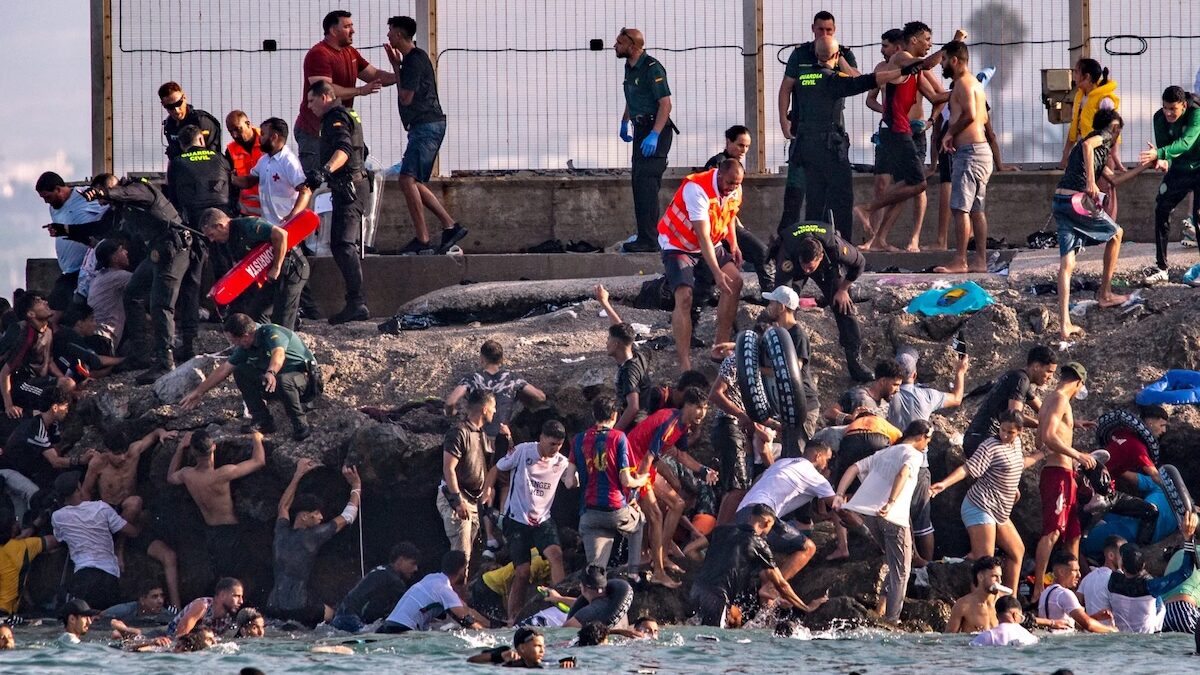
A month has passed since the migrant invasion of the Spanish exclave of Ceuta, and just as the initial shock and media outrage among European politicians faded, so too did media interest. In the public sphere, there even remains a narrative spread by incorrigible Europhile cheerleaders about how Spain somehow “handled” the whole situation. Unfortunately, the opposite is true. Spain handled absolutely nothing, and those who abuse today’s European asylum system can see that very clearly.
To begin with, it must be said that the invasion did not come out of the blue. Both Spanish exclaves on the North African coast have been the targets of incursions of varying intensity for many years. This year, even before July 30, 3,835 illegal land entries had been recorded in Ceuta, representing a year-on-year increase of more than 160%. But that was still only a warm-up for what came on July 30 and 31. According to the Spanish government, 72,000 people entered Ceuta, a city with a population of just over eighty thousand, in the course of two days.
In the fairy tales about how the Spanish government handled the situation, claims frequently appeared that practically everyone who had entered Ceuta illegally had already returned, that none of the migrants had any chance of obtaining asylum, and that none of them would make it any farther into Europe. Unfortunately, the reality is quite different.
Those who returned to Moroccan territory were mainly those who wanted to return voluntarily, and also because Morocco cooperated in doing so, which is certainly not something that can normally be expected in the case of other countries. Somewhere between five and eight thousand illegal migrants still remain in Ceuta, where they have already begun to “settle in” and are increasingly coming into conflict with local residents. While proceedings for international protection have been initiated for the adult migrants who remained there, in the case of unaccompanied minors the Spanish government is already preparing to transfer some of them to the Spanish mainland. Leaving aside the fact that, based on past experience, we can expect that many of them are not in fact minors, it is necessary to remember that under current legislation, once their stay in the EU has been legalized and they have obtained refugee status, they may, on the basis of the right to family reunification, bring their relatives to Europe. This time legally.
So no. With the benefit of hindsight, it is becoming increasingly clear that Spain failed to handle the invasion of Ceuta, just as Europe is failing to handle migration as a whole, regardless of whether it is illegal or legal migration. Ceuta was exceptional in this context only because of the enormous number of people who crossed the border within an extraordinarily short period of time.
If Europe wants to prevent the growing popularity of extremists offering simple solutions, if it wants to ensure its internal security, and if it does not want to watch people seeking a better life here die at its borders, it must fundamentally change its migration policy. In my view, this means, among other things, revising social welfare systems so that they do not create incentives for abuse, creating a genuinely functional system for returning illegal migrants, including transferring them to safe centers outside the European continent until decisions are made on their applications, and above all changing legislation that was created under completely different conditions and in an entirely different era, and which over time has made it possible for virtually anyone to abuse Europe’s hospitality, including those who deeply hate Europe and everything it symbolizes.
Only when Europe is actually capable of controlling who enters its territory and who is allowed to remain there, when final deportation orders are actually enforced, and when European states are able to protect the security of their own citizens, including in no-go zones in major European cities, only then can we seriously discuss whether we, as Europe or as individual nation-states, have successfully handled the migration crisis or not.
©2024 Milan Mikulecký. Všechna práva jsou vyhrazena.